What is end-to-end encryption? A simple explanation
End-to-end encryption means only the people in a chat can read it, not hackers, not your internet provider and not the app itself. Here is how it works, in plain words.
DiffWeb TeamPrivacy and safety
You have probably seen "end-to-end encrypted" in apps. It sounds technical, but the idea is simple, and it is one of the most important things to look for in a chat app.
The locked box idea
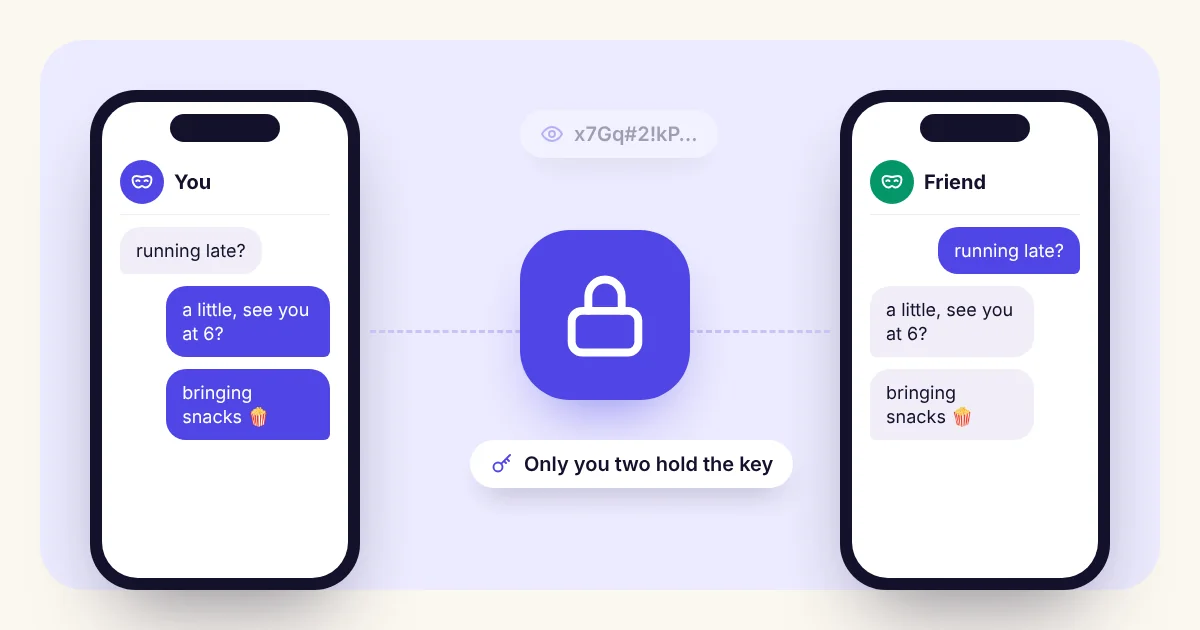
Imagine every message you send goes inside a box with a lock. Only the people in the chat have the key. The box travels across the internet and sits on the company's servers, but nobody along the way can open it: not someone on the same Wi-Fi, not your internet provider, and not the company running the app.
That is end-to-end encryption. The message is locked on your device (one "end") and only unlocked on the other person's device (the other "end").
How is that different from normal encryption?
Many services encrypt messages "in transit", on the way to their servers, and then again "at rest" on their servers. That protects you from outsiders, but the company itself holds the keys and can read your messages, or be forced to hand them over.
With end-to-end encryption, the company never has the keys. It stores locked boxes it cannot open.
How DiffWeb does it
- In a temporary room, your browser creates the room's key. The key is part of the invite link, after the
#. Browsers never send that part of a link to a website, so DiffWeb never sees it. - In Saved Rooms, Anonymous Chat and Private Circles, each of your devices makes its own key pair, and the private half never leaves that device.
- You can compare safety numbers with a friend to check that nobody else is listening in.
What encryption cannot do
Encryption is powerful, but it is not magic:
- It cannot protect a phone that someone else can unlock.
- It cannot stop the other person taking a screenshot or sharing what you sent.
- It does not hide everything. A service still needs some information to work, such as when a message was sent. A good privacy policy lists exactly what is and is not protected. Ours is on the privacy page.
The short version
End-to-end encryption means your messages are for the people in the chat and nobody else. If an app cannot say clearly that it uses it, assume someone else can read your chats.